
← Back to Applying Artificial Intelligence: Practical Paths for Teams and Organizations
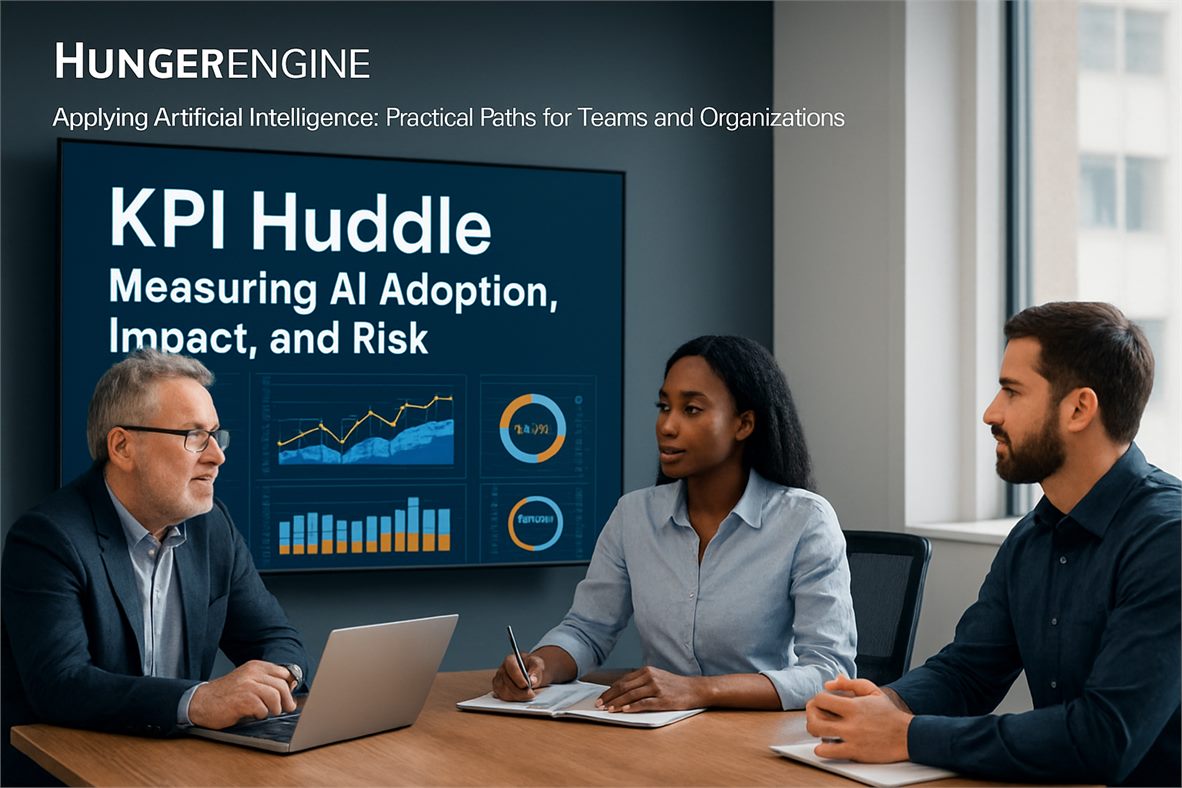
KPI Huddle: Measuring AI Adoption, Impact, and Risk
Run a recurring KPI huddle with a dashboard and guide to track AI adoption, outcomes, model quality, and operational risks for teams and organizations.
KPI Huddle: Measuring AI Adoption, Impact, and Risk
Run a short, repeatable meeting backed by a simple dashboard and conversation guide so teams can see whether AI is actually delivering value, spot regressions, and manage harms before they escalate.
What you'll understand and be able to do
You will learn a lightweight cadence and conversation structure for reviewing AI metrics that matter—not just usage numbers. By the end of the first huddle you can: pick 3–7 meaningful KPIs, populate a one-page dashboard, surface quality and safety signals, and convert observations into prioritized actions.
Who benefits
This resource is practical for cross-functional teams using AI in production, including product managers, engineers, operations leads, data scientists, compliance officers, and business owners at small and midsize companies, service organizations, hospitals, manufacturers, nonprofits, and universities. It’s designed for teams that need to balance adoption and impact with quality and operational risk—without adding bureaucratic overhead.
Why a KPI huddle matters for AI
AI systems change over time. A simple recurring forum helps teams learn from real-world performance, avoid vanity metrics, and identify signs of model drift, quality degradation, safety issues, or unintended business impacts before they become crises. The huddle focuses conversations on decisions and trade-offs so teams improve outcomes and reduce surprise.
Practical examples
- Retail store: Track chatbot conversion rate, erroneous recommendations, and customer-reported issues to balance automation with customer satisfaction.
- Healthcare clinic: Monitor triage model precision, false negative incidents, and clinician overrides to protect patient safety while increasing throughput.
- Manufacturer: Watch anomaly detection alerts, maintenance cost savings, and false positives that drive unnecessary downtime.
- Nonprofit: Measure donor outreach response lift, rate of misclassification, and privacy complaints to sustain trust while scaling outreach.
- Field services (trades): Compare AI scheduling time-savings with missed appointments and customer callbacks to confirm net benefit.
How the huddle works—simple, repeatable steps
Run the huddle weekly or biweekly for 20–45 minutes. Share a one-page dashboard before the meeting with three KPI categories: adoption (who's using what and how), outcomes (business or mission metrics tied to AI), and risk/quality (errors, incidents, bias, privacy or compliance flags). Use the conversation guide to diagnose causes, assign owners, and record follow-ups. Over time, refine metrics as you learn.
Common pitfalls to avoid
Teams often fixate on vanity metrics (API calls, number of prompts) while missing quality and harm signals. Avoid treating the huddle as a status update—use it to decide actions. Explicitly include measures for safety, fairness, and operational resilience so you don’t learn about problems only after customers or regulators do.
Where this fits in the Applying Artificial Intelligence domain
This KPI huddle is a practical step in the broader journey of applying AI to real problems: it turns pilots into disciplined production practice, connects technical teams to business outcomes, and complements other domain resources like adoption playbooks, governance checklists, and operational audits.
Next step: Use the included dashboard template and conversation guide to run your first huddle—identify one outcome metric and one quality/risk signal to track for the next two cycles, invite a cross-functional set of stakeholders, and treat the meeting as a learning loop.
Make useful resources part of something bigger.
The Hunger Engine is moving toward living domains, toolkits, and collections that people and organizations can explore, acquire, tailor, extend, and improve. A useful resource can become part of a personal collection, team toolbox, site-specific domain, or shared enterprise capability.
Start with what you're hungry to improve. As your needs grow, collections can bring together knowledge, audits, forms, dashboards, data, AI, integrations, and other capabilities without requiring you to start from scratch.