
← Back to Becoming Your Best — Practical Paths to Continuous Improvement
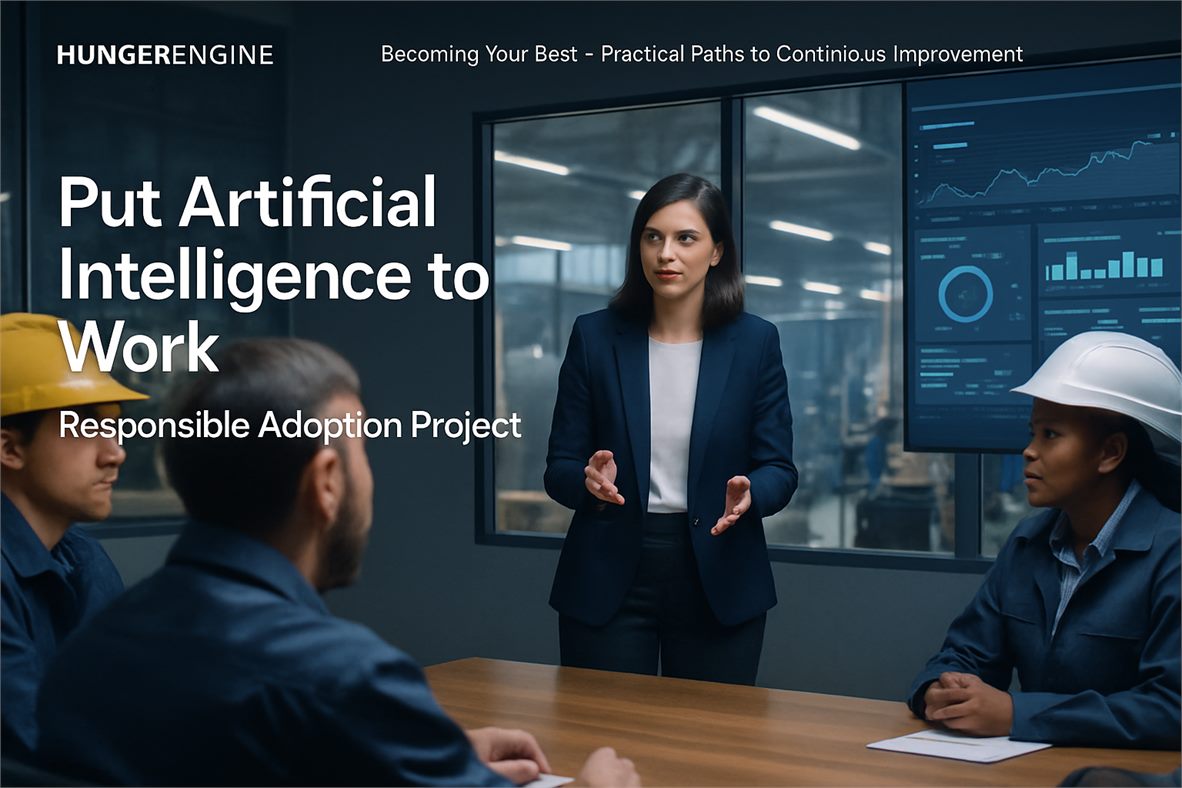
Put Artificial Intelligence to Work — Responsible Adoption Project
Free project template and steps to identify AI pilots, evaluate feasibility, and plan responsible, low‑risk adoption for teams, SMBs, and organizations.
Put Artificial Intelligence to Work — Responsible Adoption Project
Learn how to choose practical AI opportunities, run focused pilots, and adopt tools responsibly so your team gains value without exposing the organization to unnecessary risk.
What this resource helps you accomplish
This project template guides small teams, managers, consultants, and operational leaders through a step‑by‑step process to: identify high‑impact, low‑risk AI use cases; evaluate technical and operational feasibility; design short pilots; define success measures and guardrails; and create a practical adoption plan that aligns with compliance, ethics, and business priorities.
You will walk away able to run a 30–90 day pilot, assess whether the idea should scale, and document the decisions and controls that preserve trust — not just performance metrics.
Who benefits
This template is aimed at teams and organizations that want real improvements without hype: small and midsize businesses (for example, a roofing contractor automating estimates), service firms (a clinic triaging administrative requests), manufacturers (a plant testing predictive maintenance on one line), nonprofits (automating routine intake workflows), educators (grading assistance pilots), and research groups exploring augmented analysis workflows.
It’s especially useful for cross‑functional groups (operations + IT + compliance + a front‑line user) that need a common process to reduce uncertainty and preserve trust.
Why responsible adoption matters
Jumping into AI without clear goals, evaluation criteria, or guardrails can waste resources, produce biased or incorrect results, and damage trust with customers, staff, or regulators. This template emphasizes practical checks — data quality, human‑in‑the‑loop design, measurable outcomes, privacy and compliance considerations, and a realistic rollout plan — so pilots are informative and safe.
How to use the template
Start with a short workshop to generate candidate use cases and score them for value and risk. Pick one or two candidates for rapid discovery: map the current process, list data needs, draft acceptance criteria, and define a pilot scope that limits blast radius. Run the pilot with close monitoring, capture qualitative and quantitative results, and use the template’s decision checkpoints to choose whether to iterate, scale, pause, or stop.
Practical example: a regional home‑health provider used the approach to pilot an AI‑assisted scheduling assistant for care coordinators. The pilot measured time saved per coordinator, error rates in appointments, staff satisfaction, and a simple data privacy checklist before considering broader rollout.
What you’ll practice and document
The project encourages concrete deliverables you can reuse as organizational memory: a prioritized use‑case map, a feasibility note (data, skills, tools), a pilot plan with acceptance criteria, a bias and privacy checklist, monitoring metrics, and a simple scaling playbook. These artifacts help future teams avoid repeating the same mistakes.
Next steps and related paths
After completing a Responsible Adoption pilot you can explore connected resources in the Becoming Your Best domain: run a Capability & Skills Audit to see what roles you’ll need to scale, use a Decision Intelligence checklist to embed outcome tracking, or join a Huddle to share lessons across similar organizations.
Ready to begin? Use this free project template to run your first responsible AI pilot: assemble a small cross‑functional team, follow the discovery and pilot steps, and document the outcomes so your organization learns whether and how to scale.
Make useful resources part of something bigger.
The Hunger Engine is moving toward living domains, toolkits, and collections that people and organizations can explore, acquire, tailor, extend, and improve. A useful resource can become part of a personal collection, team toolbox, site-specific domain, or shared enterprise capability.
Start with what you're hungry to improve. As your needs grow, collections can bring together knowledge, audits, forms, dashboards, data, AI, integrations, and other capabilities without requiring you to start from scratch.