
← Back to Becoming Your Best — Practical Paths to Continuous Improvement
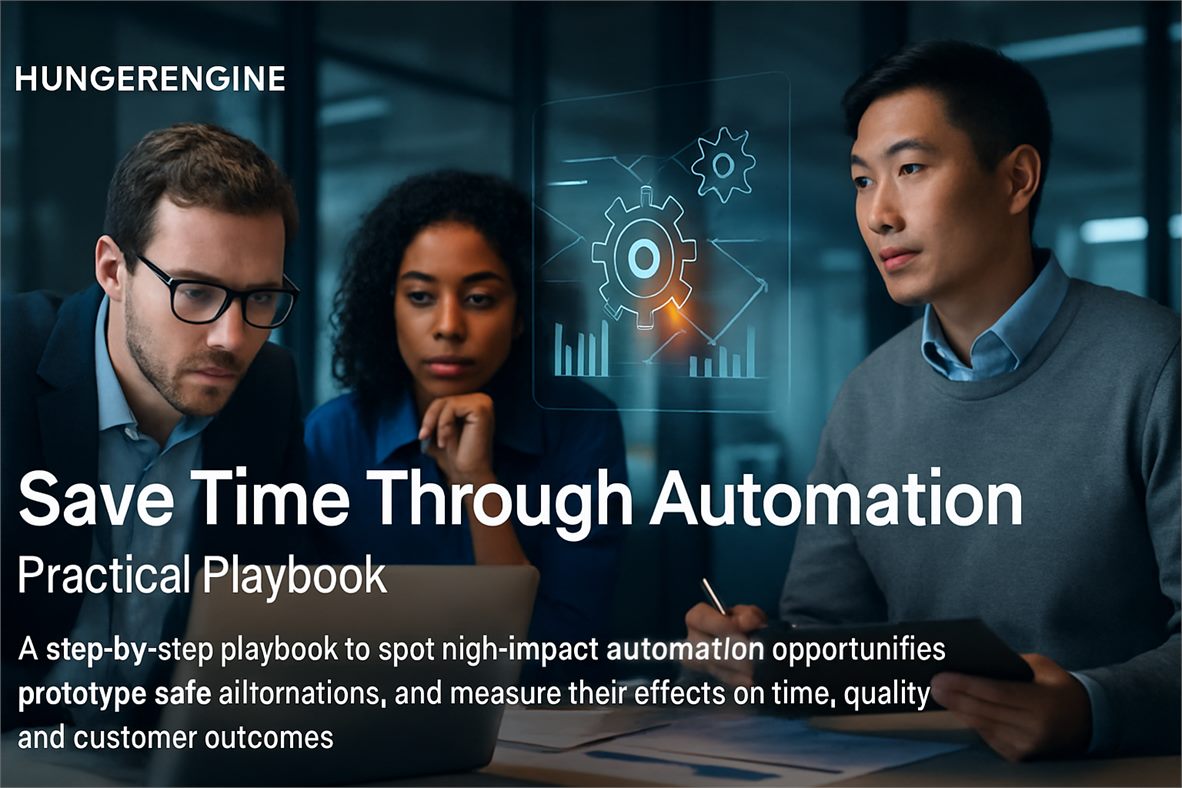
Save Time Through Automation — Practical Playbook
Find and prototype high-impact automations, measure effects on time and quality, and avoid common automation pitfalls for teams and small businesses.
Save Time Through Automation — Practical Playbook
Learn a practical, low-risk approach to reclaim routine time, cut error-prone manual steps, and scale consistent work without heavy engineering overhead.
What you'll learn and accomplish
This playbook teaches how to find the right automation opportunities, build lightweight prototypes that keep humans in the loop, and measure real effects on time, quality, and customer outcomes. You will learn a repeatable sequence: identify, estimate, prototype, validate, measure, and maintain—so teams can automate more effectively over time.
- How to prioritize automation candidates by impact and effort.
- Practical prototyping patterns that limit risk and preserve human checks.
- Simple metrics and tests to quantify time saved, error reduction, and customer impact.
- Guidelines for governance, maintenance planning, and when not to automate.
Who benefits
This playbook is written for people who run or do repeatable operational work and want to reduce routine burden without creating fragile processes. Typical users include small business owners, operations managers, team leads, frontline supervisors, consultants, and practitioners in service companies, skilled trades, nonprofits, schools, clinics, and factories.
Examples of practical uses:
- A restaurant manager automating daily inventory checks and order reminders to reduce rush-hour errors.
- A roofing contractor turning paper job logs into a simple digital intake plus an automated follow-up schedule.
- A nonprofit director prototyping automated application-status notifications while keeping caseworkers in control of sensitive decisions.
- A manufacturing line supervisor using lightweight sensors and alerts to reduce inspection time and catch defects earlier.
How to use this playbook
Start small and learn: pick one routine task, map the current process, estimate time and failure modes, build a safe prototype, measure results, and decide whether to scale or iterate. Use short experiments (days to weeks) and keep people who understand the work involved in testing and governance.
Suggested steps:
- Map the process and identify pain points (time sinks, handoffs, common errors).
- Estimate impact and effort—focus on high-impact, low-fragility candidates.
- Prototype with human-in-the-loop automation to limit risks.
- Measure time saved, error changes, and any customer-facing effects.
- Create a maintenance plan and clear ownership before scaling.
Risks, boundaries, and safeguards
Automation can amplify problems if applied to the wrong processes. Common pitfalls include automating poorly understood work, removing critical human checks, and accumulating maintenance debt. This playbook highlights guardrails: keep critical decisions human-supervised, document fallback procedures, and require small, reversible experiments.
Ready to reduce routine work without adding risk? Use this playbook to run your first experiment, bring findings to your next team huddle, or combine it with continuous improvement practices from the Becoming Your Best domain.
Make useful resources part of something bigger.
The Hunger Engine is moving toward living domains, toolkits, and collections that people and organizations can explore, acquire, tailor, extend, and improve. A useful resource can become part of a personal collection, team toolbox, site-specific domain, or shared enterprise capability.
Start with what you're hungry to improve. As your needs grow, collections can bring together knowledge, audits, forms, dashboards, data, AI, integrations, and other capabilities without requiring you to start from scratch.