
← Back to Building Better Organizations
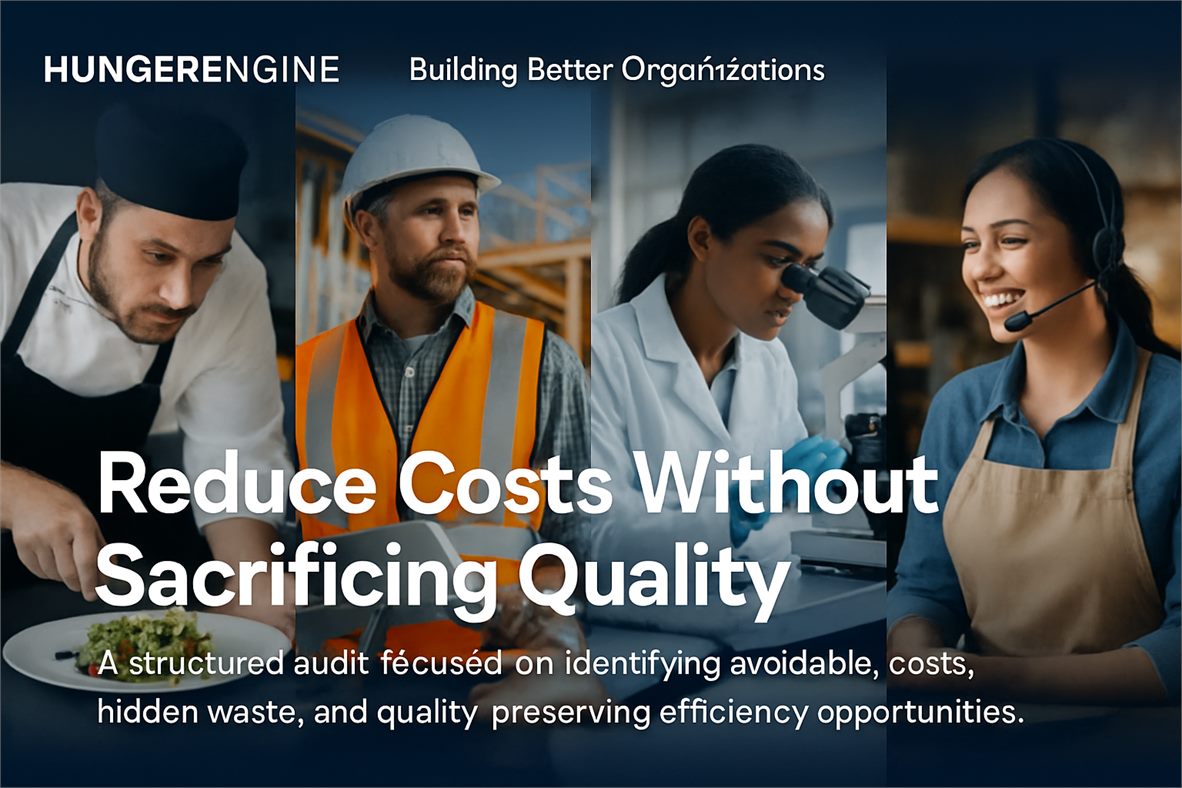
Reduce Costs Without Sacrificing Quality (Audit)
A structured audit to uncover avoidable costs, hidden waste, and quality-preserving efficiency opportunities for managers and teams.
Reduce Costs Without Sacrificing Quality — Audit
This practical audit helps managers and teams free up resources for strategic priorities by finding avoidable costs and hidden waste without increasing rework, safety risks, or compliance exposure.
What you'll understand and accomplish
You will learn how to spot cost drivers that do not add customer value, measure the quality impact of savings, and prioritize changes that preserve or improve outcomes. Use the audit to produce a short, prioritized action plan with quick wins, mid-term fixes, and a monitoring approach so savings are real and sustainable.
- Assess where spending delivers value — and where it doesn’t
- Identify hidden waste: rework, delays, overproduction, and excess inventory
- Evaluate cost-reduction options against quality, safety, and compliance risk
- Create a prioritized, owner-assigned improvement plan with measurement
Who benefits
This audit is suitable for operations managers, small business owners, quality leaders, service managers, nonprofit directors, and team leads who must reduce costs without undermining service, product quality, safety, or regulatory compliance. It fits organizations of many sizes — from a two-person trades crew to a mid-sized manufacturer or clinic — wherever leaders need practical, low-risk savings.
How the audit works (practical steps)
Run the audit with a cross-functional team over one to four weeks depending on scope. Key steps:
- Frame the review: Define the goal, time horizon, and constraints (safety, compliance, quality standards).
- Map the process and costs: Document the end-to-end workflow, handoffs, and where labor, materials, and overhead are consumed.
- Measure quality and failure points: Track rework, defects, delays, customer complaints, or safety incidents tied to the process.
- Identify non-value activities: Look for repetition, overproduction, excessive inspection, or unnecessary approvals.
- Generate and screen ideas: Propose changes, then quickly assess impact vs. risk to quality or compliance.
- Pilot and measure: Run small experiments to confirm savings and verify no unintended quality degradation.
- Prioritize and assign: Create a time-bound plan with owners, success metrics, and monitoring rules.
Practical examples
Examples show how the audit applies across contexts:
- A restaurant manager reduces food waste and prep time by standardizing prep batches and adjusting inventory par levels, preserving dish quality and service speed.
- A roofing contractor trims indirect costs by consolidating supplier orders and simplifying invoicing, while keeping material standards and warranty processes intact.
- A small manufacturer cuts changeover time using a quick-change checklist and improved tooling storage, reducing production downtime without raising defect rates.
- A community clinic reduces administrative duplication by consolidating forms and automating a few routine reminders, improving staff capacity while protecting patient safety and records privacy.
What to watch out for (risks and boundaries)
Avoid across-the-board cuts that erode capability, increase rework, or create safety or compliance risk. The audit focuses on targeted, measured changes and pilots so savings are real and do not shift costs to customers, staff, or other parts of the organization.
Next steps: Use this audit to run a focused review with your team, produce a prioritized improvement plan, and pair it with related work on quality and process simplification. For further learning, explore adjacent topics in Building Better Organizations such as "Improve Quality and Reduce Errors," "Simplify Processes and Eliminate Waste," and "Make Better Decisions with Better Information."
Ready to start the audit? Begin with a 1–2 hour scoping meeting to frame goals and risks, then follow the steps above to identify and pilot cost-saving opportunities that protect quality.
Make useful resources part of something bigger.
The Hunger Engine is moving toward living domains, toolkits, and collections that people and organizations can explore, acquire, tailor, extend, and improve. A useful resource can become part of a personal collection, team toolbox, site-specific domain, or shared enterprise capability.
Start with what you're hungry to improve. As your needs grow, collections can bring together knowledge, audits, forms, dashboards, data, AI, integrations, and other capabilities without requiring you to start from scratch.