
← Back to Healthcare & Patient Care
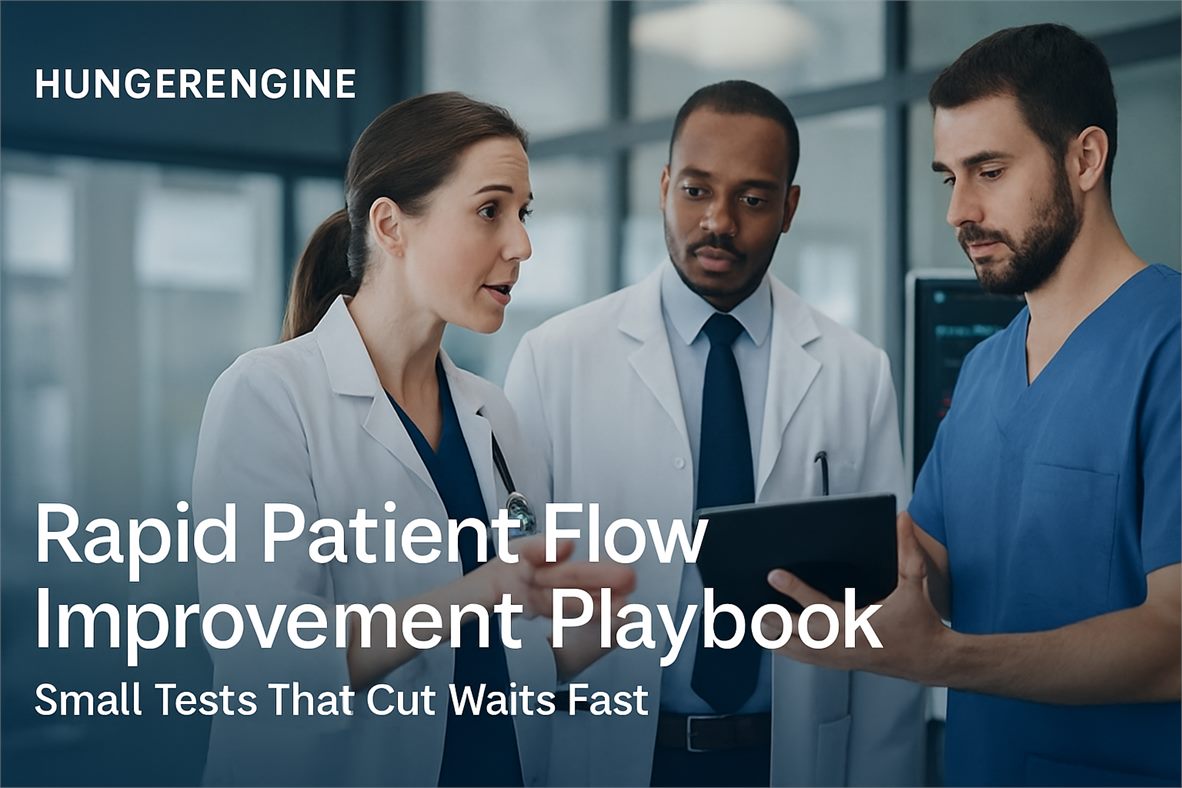
Rapid Patient Flow Improvement Playbook: Small Tests That Cut Waits Fast
A field-ready playbook of rapid experiments, metrics, and simple countermeasures for supervisors and care teams to reduce patient waits safely.
Rapid Patient Flow Improvement Playbook: Small Tests That Cut Waits Fast
Practical, low-risk experiments and simple countermeasures supervisors and care teams can run this week to reduce wait times while keeping care safe and compassionate.
Why this matters
Long waits and poor flow harm patient experience, increase staff stress, and erode capacity. This playbook focuses on quick, staff-led experiments you can run in hours or days—streamlined check-in, fast-track lanes, order sequencing, better handoffs—so teams learn what works before committing to big redesigns or costly technology. It emphasizes staff involvement, clear ownership, and measurable outcomes.
Who benefits
This resource is aimed at frontline supervisors, improvement coaches, charge nurses, clinic managers, ED leaders, and operations staff who need actionable steps to reduce waits without disrupting safety or care quality. It’s also useful to quality and process improvement teams translating manufacturing concepts—flow, bottlenecks, takt, and standard work—into healthcare improvements.
What you'll understand and be able to do
After using the playbook you will be able to:
- Identify the most impactful short-tests to run now and assign clear ownership.
- Use simple metrics (arrival-to-provider, door-to-disposition, queue length, and cycle time) to track change and spot unintended effects.
- Run rapid Plan-Do-Study-Act cycles with front-line staff and record what you learn.
- Implement practical countermeasures—streamlined check-in, fast-track lanes, order sequencing, standard handoffs—that reduce delays without major capital spend.
- Connect local tests to broader operational goals such as reducing bottlenecks, improving throughput, and stabilizing shift-to-shift performance.
Real-world examples
Examples you can adapt: create a 30-minute fast-track in a crowded urgent-care shift; redesign triage check-in to remove duplicate paperwork; sequence lab and imaging orders so results arrive before provider decision points; run a 1-week trial of a standard handoff checklist between triage and treatment bays. These are small, observable experiments—not wholesale redesigns.
How this connects to Intelligent Manufacturing & Operations
The playbook applies proven operations ideas from manufacturing—identify bottlenecks, make work visible, test standard work, and use short-cycle experiments—to healthcare flow problems. Treat patient flow like a production system: improving throughput and reducing variability increases capacity and reduces stress on staff.
Make useful resources part of something bigger.
The Hunger Engine is moving toward living domains, toolkits, and collections that people and organizations can explore, acquire, tailor, extend, and improve. A useful resource can become part of a personal collection, team toolbox, site-specific domain, or shared enterprise capability.
Start with what you're hungry to improve. As your needs grow, collections can bring together knowledge, audits, forms, dashboards, data, AI, integrations, and other capabilities without requiring you to start from scratch.