
← Back to Healthcare & Patient Care
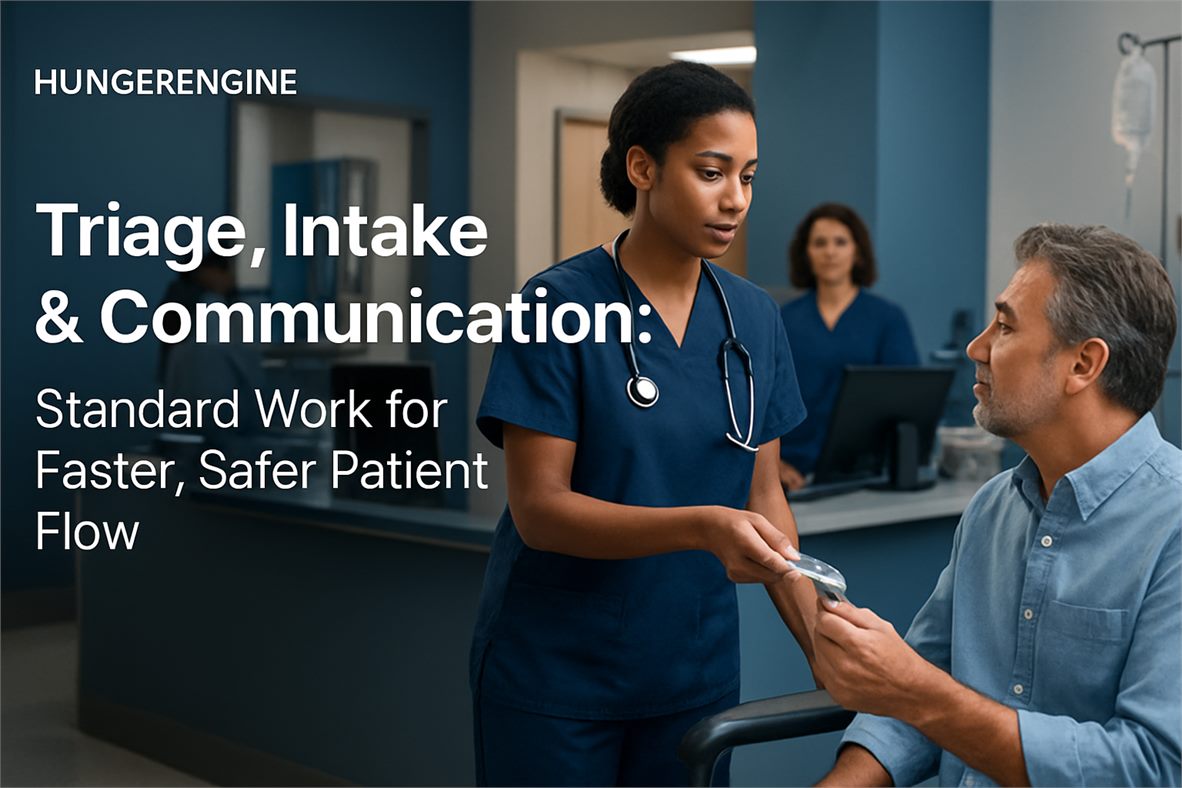
Triage, Intake & Communication: Standard Work for Faster, Safer Patient Flow
Templates and scripts for triage, front‑desk intake, digital check‑in, and patient communication to reduce delays and improve throughput and experience.
Triage, Intake & Communication: Standard Work for Faster, Safer Patient Flow
Use simple, consistent intake and triage steps—scripts, checklists, and handoffs—to reduce ambiguity at first contact, move patients more reliably through care, and improve safety and experience.
Why consistent triage and intake matter
Delays and misdirection often start at the first phone call, front desk interaction, or digital check‑in. When intake is ad hoc, patients wait longer, clinicians get interrupted by avoidable questions, and urgent needs can be missed. Clear standard work makes decisions faster, reduces back‑and‑forth, and creates a predictable patient journey across emergency departments, primary care clinics, ambulatory imaging centers, and community health sites.
What you'll understand, practice, and accomplish
- Understand the critical steps and decision points in triage, reception intake, and digital check‑in.
- Practice ready‑to‑use scripts for phone triage, front‑desk conversations, and patient messaging that reduce ambiguity and escalation.
- Use intake templates and simple checklists to standardize information capture and handoffs to clinical teams.
- Run a quick team huddle to adapt scripts and test changes during a short pilot.
- Identify simple measures to track improvement (for example: misdirected visits, number of clarifying calls, or percent of patients who complete check‑in before arrival).
Who benefits
This resource helps frontline clinicians, reception and scheduling teams, patient experience leaders, clinic managers, ED supervisors, and small practice owners who need reliable, low‑friction ways to move patients through first contact. It’s also useful for quality improvement facilitators and safety officers who want practical standard work to embed in orientation and daily huddles.
Practical examples you can adapt
- An urgent care clinic uses a 3‑question phone triage script to decide same‑day visits vs. telehealth and reduce walk‑in congestion.
- A primary care office standardizes front‑desk phrasing to collect medication allergies and reason for visit, cutting repeated clinician calls.
- An outpatient imaging center implements a digital pre‑check template so technologists receive complete prep information before patient arrival.
How this fits into Intelligent Healthcare & Patient Care
Standardized triage and intake are foundational to patient safety, care coordination, and operational flow. Use these templates alongside your quality improvement work—shift handoff best practices, patient communication protocols, and simple measurement plans—to help your organization become more reliable and learn from every patient encounter.
Get started: review the templates and scripts, run a 15‑minute huddle to tailor them to your setting, and try a one‑week pilot at one site to see what changes next. If you’re part of a larger improvement effort, pair this work with a short intake audit and a follow‑up huddle to refine standard work.
Make useful resources part of something bigger.
The Hunger Engine is moving toward living domains, toolkits, and collections that people and organizations can explore, acquire, tailor, extend, and improve. A useful resource can become part of a personal collection, team toolbox, site-specific domain, or shared enterprise capability.
Start with what you're hungry to improve. As your needs grow, collections can bring together knowledge, audits, forms, dashboards, data, AI, integrations, and other capabilities without requiring you to start from scratch.