
← Back to Research & Discovery
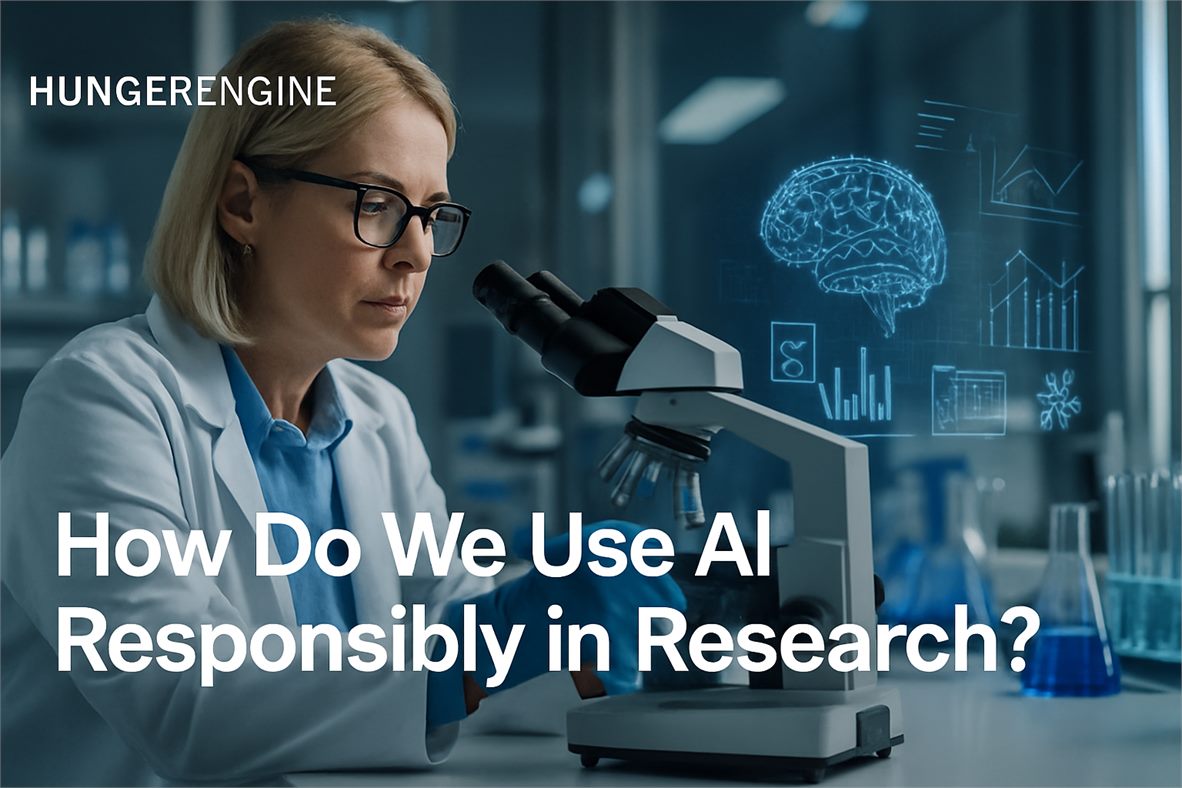
How Do We Use AI Responsibly in Research?
Practical guidance for applying AI in research: identify value, validate models, manage risks, document provenance, and keep workflows reproducible.
How Do We Use AI Responsibly in Research?
Learn when and how to apply AI to accelerate discovery without sacrificing scientific rigor: validate models, manage risks, record provenance, and integrate AI steps into reproducible research workflows.
What you'll understand and be able to do
By reading and practicing the ideas here you will be able to: identify research tasks where AI provides clear value (e.g., literature synthesis, image analysis, anomaly detection), design validation plans that match your scientific questions, document model provenance and assumptions, monitor models for drift or bias, and embed AI outputs in reproducible pipelines that other researchers can inspect and repeat.
Who benefits
This resource is aimed at researchers, lab leads, data scientists, research software engineers, clinical investigators, regulatory and quality staff, and managers who need to introduce AI into experiments, analysis, or operations without creating opaque, non-reproducible workflows. It applies to individual investigators, small labs, service teams, and larger research organizations alike.
Practical steps and concrete examples
Start with a clear question: what decision or insight will AI improve? Then map inputs, outputs, and success criteria. Example workflows:
- A microscopy lab uses a lightweight segmentation model to speed cell counts; the team defines acceptance thresholds, compares automated counts to blinded manual counts, and records training data provenance and versioned model parameters.
- A clinical research group uses a predictive model for trial enrollment risk; they run external validation on held-out cohorts, document inclusion/exclusion criteria, and add human review for high-stakes decisions.
- An environmental project uses NLP to surface relevant papers; researchers keep the search prompts, model versions, and filtering rules in the project record so results can be audited and extended later.
Across examples, emphasize simple validation (train/test splits, external cohorts, calibration checks), interpretability (feature importance, counterfactual checks), and reproducibility (containerized code, data and model provenance, clear README and notebooks).
Common pitfalls to avoid
Avoid treating models as infallible: do not rely on black-box outputs without validation; do not skip documenting datasets, pre-processing, or model versions; and do not deploy unmonitored models into production research processes where drift or bias can silently undermine results. These gaps create reproducibility and ethical risks.
How this connects to Intelligent Research & Discovery
This guidance complements the Intelligent Research & Discovery domain by focusing on trustworthy AI practices that preserve experimental integrity. Use these practices alongside literature review, experimental design, data management, and collaboration workflows to turn AI from a risky shortcut into a reliable accelerator of discovery.
Next steps: translate these ideas into your next project by drafting a short AI validation checklist, running a small reproducibility test, or convening a team huddle to agree on provenance, acceptance criteria, and monitoring. If you want, start with one concrete task—such as validating a model on a new cohort—and build from there.
Make useful resources part of something bigger.
The Hunger Engine is moving toward living domains, toolkits, and collections that people and organizations can explore, acquire, tailor, extend, and improve. A useful resource can become part of a personal collection, team toolbox, site-specific domain, or shared enterprise capability.
Start with what you're hungry to improve. As your needs grow, collections can bring together knowledge, audits, forms, dashboards, data, AI, integrations, and other capabilities without requiring you to start from scratch.