
← Back to Leadership & Collaboration
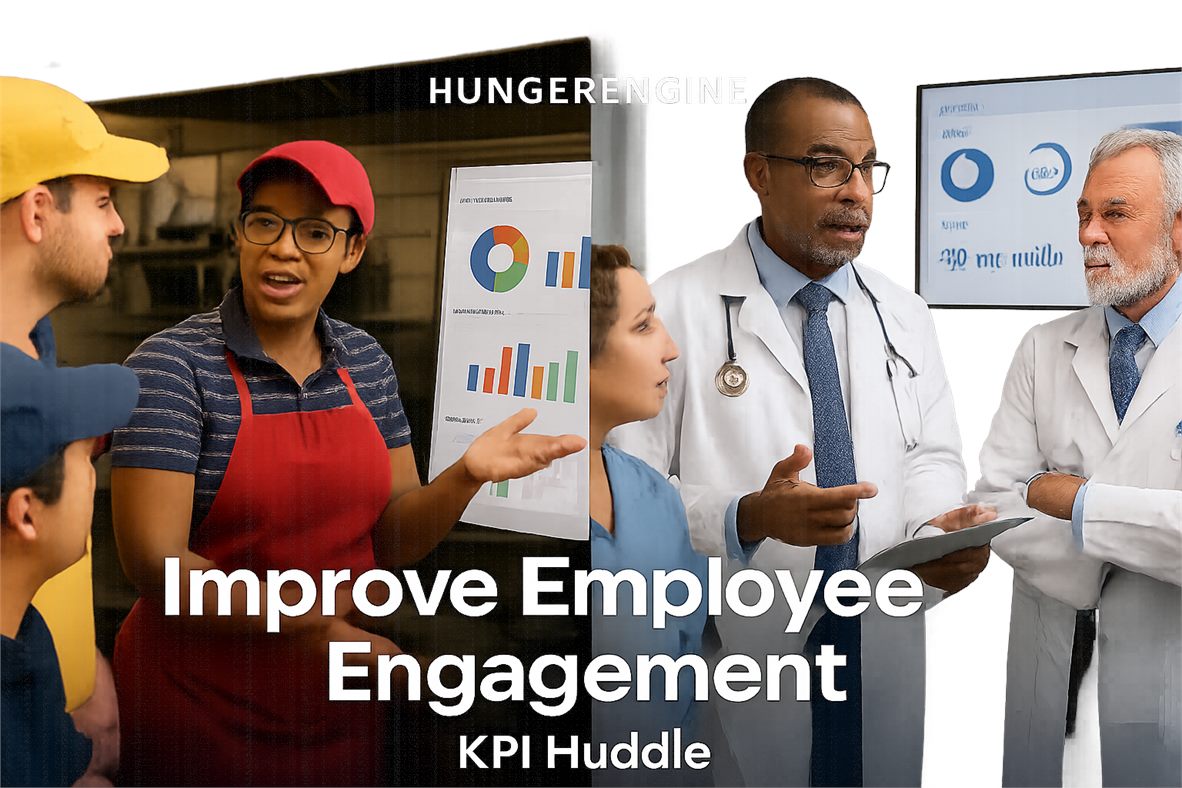
Improve Employee Engagement — KPI Huddle
A practical recurring huddle format to track engagement indicators, surface causes, and coordinate rapid interventions across teams.
Improve Employee Engagement — KPI Huddle
Run a short, regular huddle that turns engagement data into coordinated action — not just dashboards.
Why this matters
Leaders and HR partners often get regular engagement reports but no clear way to translate trends into timely support. This KPI huddle gives teams a simple, repeatable rhythm to notice changes, align on causes, commit to small experiments, and coordinate cross-functional help before problems grow.
Who benefits
Team leads, HR business partners, operations managers, and cross-functional leaders in organizations of any size — from a restaurant manager coordinating shift staffing to a plant manager reducing turnover on a production line, a nonprofit director improving volunteer retention, or a school principal supporting teacher morale. The format is also useful for small-business owners and service providers who want a practical meeting to turn feedback into action.
What you'll understand and practice
You will learn how to: pick a small set of meaningful engagement indicators; run a short agenda that turns indicator changes into named barriers and actions; assign owners and timelines; and follow up so experiments become learning. You will practice surfacing root causes in a brief conversation, coordinating support across functions (e.g., HR, operations, front-line leadership), and tracking whether interventions change behaviors, not just metrics.
Simple example agendas and uses
Suggested huddle flow you can adapt: quick indicator check (trend, not raw dashboards), surface one barrier or story, decide one action owner and timeline, note required support, and confirm follow-up. Examples: a roofing contractor's weekly huddle flags fatigue after a busy season and arranges temporary crews; a restaurant manager uses a post-shift weekly huddle to reduce no-shows by changing scheduling practices; a researcher group converts low survey response into a short in-person check-in and redesigns the pulse question.
Common pitfalls to avoid
Avoid turning this into a monthly dashboard review with no agreed actions, running isolated initiatives that lack cross-functional support, or relying on vanity metrics that don’t link to observable behaviors. The goal is to create a learning rhythm: small, evidence-informed adjustments with clear owners and visible follow-up.
How this connects to Leadership & Collaboration
This huddle is a practical part of building organizations that learn together: it strengthens team communication, accountability, and trust by turning insight into coordinated action. Use it alongside efforts to improve meeting effectiveness, coaching conversations, and conflict resolution so engagement work becomes part of everyday leadership practice rather than a siloed program.
Try this: run a pilot huddle with one team for 4 weekly cycles. Start with two engagement indicators, a 30-minute agenda, and a single owner for each action. After four meetings, reflect on what changed, what you learned, and what to scale next.
Make useful resources part of something bigger.
The Hunger Engine is moving toward living domains, toolkits, and collections that people and organizations can explore, acquire, tailor, extend, and improve. A useful resource can become part of a personal collection, team toolbox, site-specific domain, or shared enterprise capability.
Start with what you're hungry to improve. As your needs grow, collections can bring together knowledge, audits, forms, dashboards, data, AI, integrations, and other capabilities without requiring you to start from scratch.