
← Back to Operational Excellence Hub
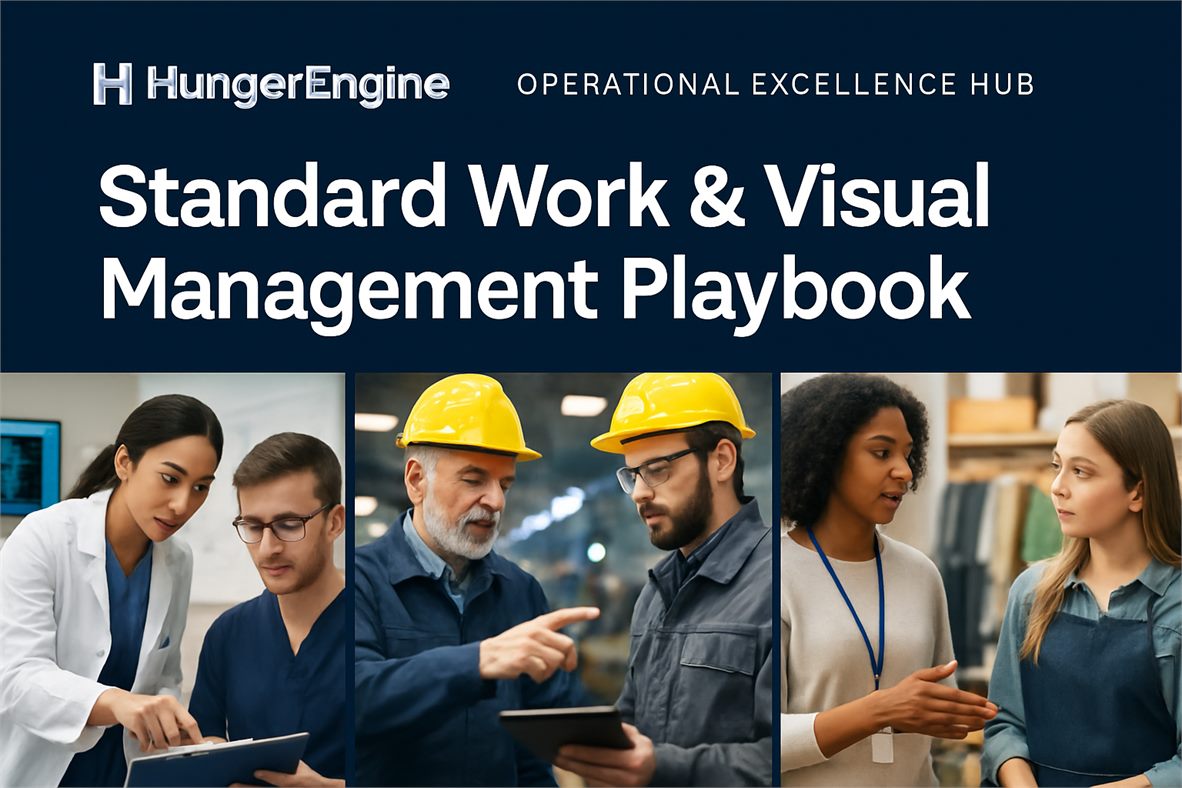
Standard Work & Visual Management Playbook
Practical steps to create, test, train, and continually improve standard work with simple visual controls for teams and frontline operations.
Standard Work & Visual Management Playbook
Learn how to define clear, testable standard work and pair it with simple visual controls so teams reduce variation, onboard faster, and surface problems early—without turning standards into paperwork that ignores frontline insight.
What you'll learn
This playbook walks you through five practical habits: identify critical tasks, document the safest and most reliable method, test and validate steps with frontline staff, teach through deliberate practice, and use visual signals to make the right action obvious. It focuses on usable, lightweight artifacts (checklists, step-by-step job guides, shadow boards, color-coded cues, and simple boards) rather than heavy manuals.
Why it matters for operational performance
When work is clear and visible, teams spend less time guessing, errors are easier to detect, onboarding accelerates, and daily improvement becomes possible. This resource shows how to make standards a living part of daily work—one that invites improvement instead of enforcing rigidity.
Who benefits
Frontline teams and their leaders in manufacturing, healthcare, restaurants, skilled trades, maintenance, cleaning services, nonprofit operations, and small businesses will get the most value. Examples include a roofing crew standardizing shingling and handoff steps, a clinic improving nursing shift handovers, a bakery running consistent morning prep, and a facilities team creating visual maintenance schedules.
How to use this playbook (practical steps)
Start by choosing a high-impact, repeatable task. Map the current steps with the people who do the work. Write a concise, step-by-step standard that includes purpose, key checkpoints, and safety notes. Validate the standard through short tests and observations, then train by practicing the sequence together. Introduce visual controls—labels, color codes, shadow boards, simple boards showing status or targets—to make deviations visible. Close the loop with quick daily or weekly checks and a simple improvement ritual so standards evolve with frontline learning.
Common pitfalls and how to avoid them
Standard work can become counterproductive when it is treated as fixed paperwork or when it excludes the people who do the job. Avoid these risks by keeping standards short, co-created with operators, time-boxed for review, and paired with experiments: test changes for a shift or day, collect feedback, and update the standard. Use visual management to highlight exceptions rather than to punish deviations.
Practical examples and quick wins
Try these low-effort experiments: a 10-step starter standard for a single workstation, a laminated one-page checklist for new hires, a color band on tool handles to indicate tool family, a floor tape layout to guide material flow, or a simple status board that flags stalled work. Each quick win makes it easier to run larger, multi-step standards consistently.
Ready to start? Pick a repeatable task, gather the people who do it, and follow the playbook steps to write, test, and visualize the work. If you lead a team, schedule a short huddle to try the first test and collect feedback—then iterate.
Make useful resources part of something bigger.
The Hunger Engine is moving toward living domains, toolkits, and collections that people and organizations can explore, acquire, tailor, extend, and improve. A useful resource can become part of a personal collection, team toolbox, site-specific domain, or shared enterprise capability.
Start with what you're hungry to improve. As your needs grow, collections can bring together knowledge, audits, forms, dashboards, data, AI, integrations, and other capabilities without requiring you to start from scratch.