
← Back to Sustainability & Environmental Stewardship
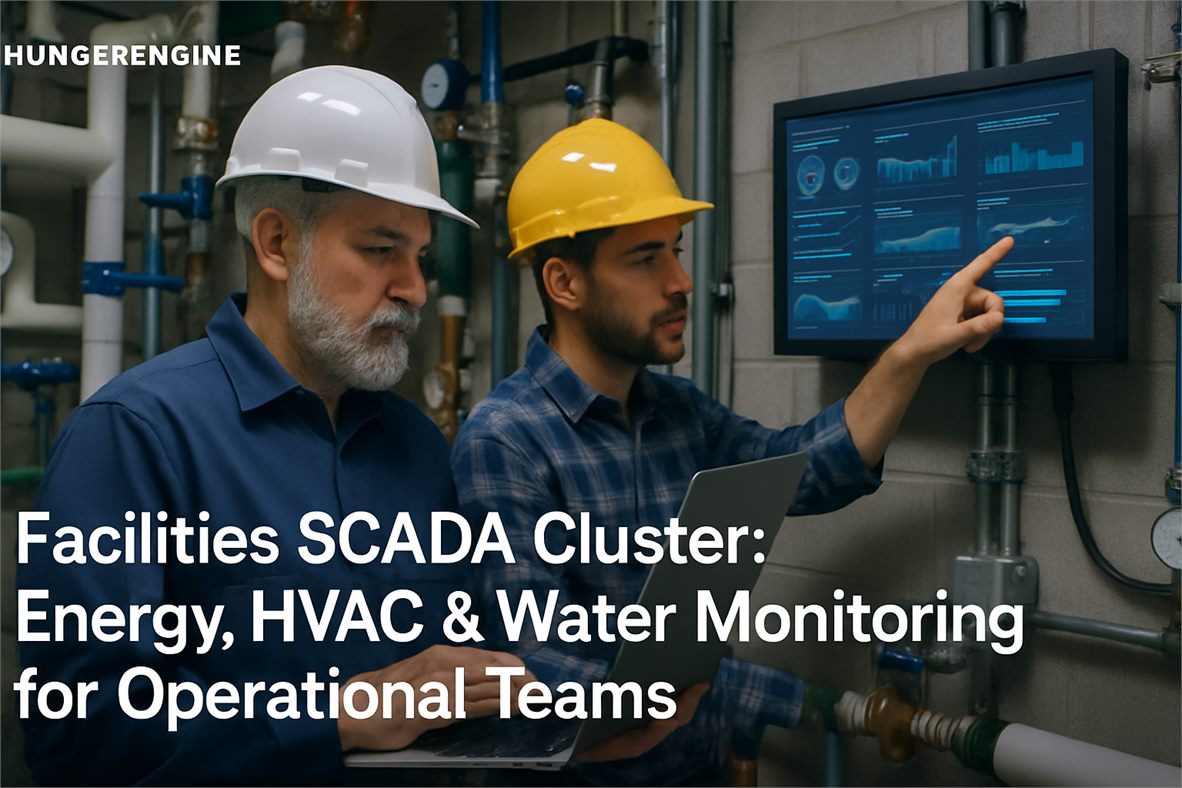
Facilities SCADA Cluster: Energy, HVAC & Water Monitoring for Operational Teams
Monitoring configs, alerts, and dashboards for operations teams to detect inefficiency, validate fixes, and prevent energy and water waste.
Facilities SCADA Cluster: Energy, HVAC & Water Monitoring for Operational Teams
Practical monitoring patterns, alert rules, and dashboard designs operations teams use to spot waste, confirm repairs, and prevent recurring failures across energy, HVAC, and water systems.
Why this resource matters
Operational telemetry—meters, pumps, valves, VFDs, chiller data, and water sensors—contains early signals of inefficiency and failure. When teams can see the right signals, tuned to the right thresholds, they act sooner, validate fixes, and stop waste before it becomes a crisis. This work directly supports sustainability goals by reducing energy and water loss while strengthening reliability and resilience.
What you'll understand and be able to do
This resource teaches monitoring patterns and practical steps you can apply today:
- Identify high-value signals: energy baselines, HVAC run-time vs demand, chilled-water delta‑T, unoccupied-hours loads, abnormal flow or pressure drops, and unusual pump cycling.
- Design compact dashboards that surface anomalies and before/after snapshots for measuring interventions.
- Write and tune alert rules to reduce false positives and avoid alert fatigue—prioritizing actionable, triaged signals.
- Validate fixes with simple before/after tests and short measurement windows so teams can confirm impact quickly.
- Close the loop between detection and maintenance so fixes are tracked, verified, and learned from over time.
Who benefits
Operations managers, facilities engineers, building supervisors, maintenance technicians, sustainability leads, and consultants will find this resource useful. It is practical for small sites (a restaurant or clinic), institutional facilities (schools, hospitals), industrial plants and manufacturing lines, property managers, and municipal utilities that want to reduce waste and improve uptime.
Practical examples
Examples show how the patterns apply across contexts:
- Hospital: track chiller delta‑T and chilled-water pump behavior to detect reduced heat transfer and trigger a work order before patient-impacting outages.
- Manufacturing plant: monitor compressed-air flow and pressure drops to pinpoint leaks and validate repairs with pre/post energy use snapshots.
- Office building: detect overnight HVAC runtime and cross-check with occupancy schedules to shut down systems during extended vacancy.
- Wastewater facility: combine flow and level telemetry to detect stuck valves or pump staging errors that cause excess energy use and process risk.
Common pitfalls and how to avoid them
Monitoring works when it is focused and connected. Avoid these common mistakes:
- Over-instrumentation and complex dashboards that hide the signal—start with a few high‑value metrics and expand only when needed.
- Poorly tuned alerts that generate noise—use thresholds, rate-of-change checks, and short confirmation windows to reduce false alarms.
- Disconnected workflows so detection does not lead to repair—link alerts to clear maintenance actions, owners, and verification steps.
- No validation: failing to measure the outcome of a repair eliminates learning—always collect short before/after data to confirm impact.
How to use this collection
Work through a simple cycle: map your sensors, choose 3–5 core signals, build a compact dashboard, set prioritized alerts, run tests to validate fixes, and document outcomes for teammates. Repeat in short cycles to build confidence and reduce risk. Use this resource as part of your broader Sustainability & Environmental Stewardship practice to make measurable, continuous improvements.
This guidance is educational and operationally focused; consult licensed engineers or compliance specialists for design, safety-critical work, or regulatory matters.
Make useful resources part of something bigger.
The Hunger Engine is moving toward living domains, toolkits, and collections that people and organizations can explore, acquire, tailor, extend, and improve. A useful resource can become part of a personal collection, team toolbox, site-specific domain, or shared enterprise capability.
Start with what you're hungry to improve. As your needs grow, collections can bring together knowledge, audits, forms, dashboards, data, AI, integrations, and other capabilities without requiring you to start from scratch.