
← Back to Sustainability & Environmental Stewardship
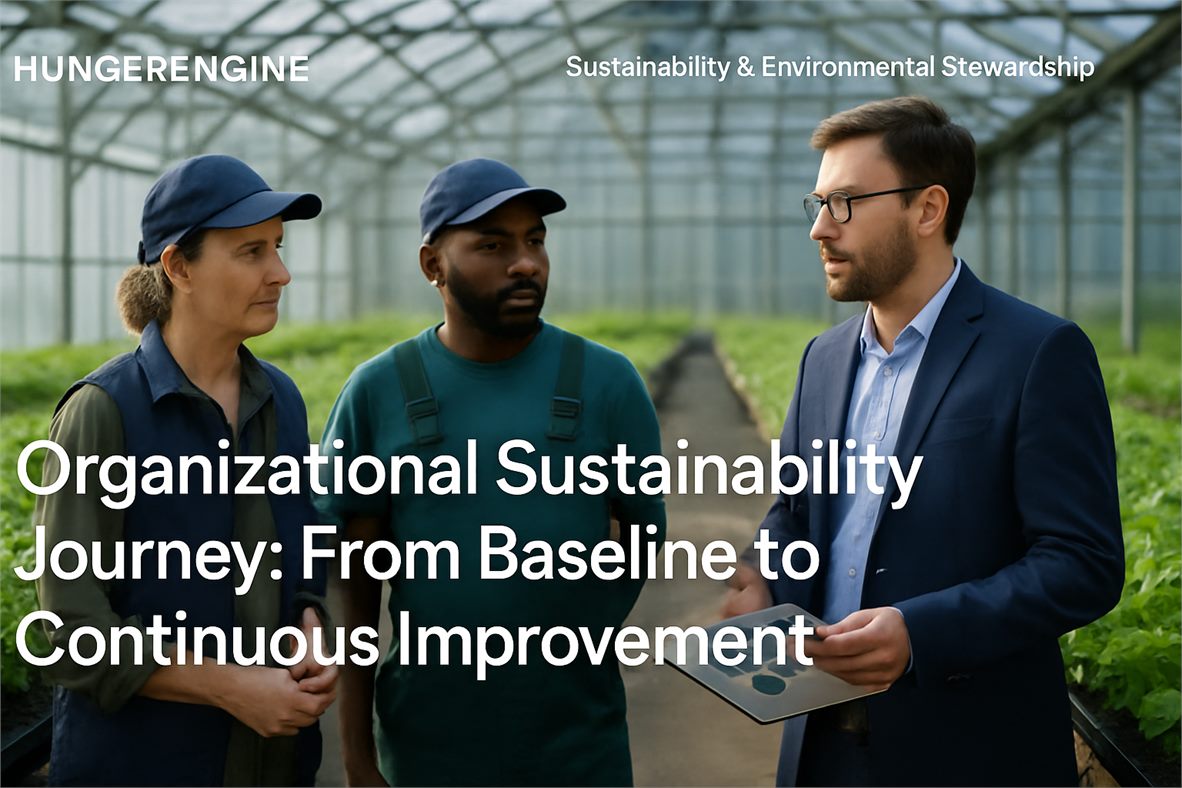
Organizational Sustainability Journey: From Baseline to Continuous Improvement
A practical multi-phase guide to help teams assess baseline, prioritize actions, pilot solutions, measure results, and embed continuous sustainability improvement.
Organizational Sustainability Journey: From Baseline to Continuous Improvement
This resource walks teams through a clear, practical sequence of phases—baseline, prioritize, pilot, scale, and continuous improvement—so sustainability ambition becomes repeatable operational progress.
What you'll understand, practice, and accomplish
You will learn how to map your current environmental footprint, choose high-impact priorities, run small tests with clear success criteria, measure real operational improvements, and create feedback loops so wins grow into lasting practices. The emphasis is on simple, repeatable steps that teams—whether a restaurant owner, a school facilities team, a manufacturer's plant floor crew, or a nonprofit director—can use to make steady, measurable progress.
Who benefits
This pathway is most useful for teams and leaders who must turn sustainability goals into day-to-day operations: sustainability coordinators, operations managers, facilities staff, small business owners, frontline supervisors, project teams, and consultants supporting them. It's designed for groups ready to collect modest amounts of data, assign clear roles, and test practical changes—not for organizations seeking a one-off checklist without follow-up.
How the journey connects to Sustainability & Environmental Stewardship
Think of this resource as the operational bridge between strategy and results in the Sustainability & Environmental Stewardship domain. It links baseline assessment and measurement to improvement practices such as waste reduction, energy efficiency, water conservation, circular design, and employee engagement. Use it alongside measurement approaches, dashboards, and continuous-improvement methods to turn insights into lasting operational change.
Overview: five practical phases
Follow these phases as a sequence, not separate projects:
- 1. Baseline & discovery — map processes, gather simple measurements, and capture frontline observations (e.g., energy usage patterns at a café; material loss on a shop floor).
- 2. Prioritize & plan — choose a few high-impact opportunities, set clear metrics, and assign accountable roles (ops lead, data owner, frontline champion).
- 3. Pilot & learn — run small tests with defined success criteria, gather data, and document what worked and why.
- 4. Scale & standardize — adapt procedures, train teams, update checklists, and embed changes into routine work.
- 5. Monitor & continuously improve — schedule regular reviews, measure trends, share lessons, and iterate on next priorities.
Avoid common pitfalls
Without a journey, efforts often remain fragmented: pilots stall, measurement is inconsistent, and short-term wins fade. Reduce risk by keeping metrics consistent, documenting learning, assigning clear ownership, and planning how pilots will be evaluated and scaled before starting them.
Start with a simple 90-day exercise
Pick one measurable KPI (e.g., food waste weight per service, energy use per machine-hour, or water use per classroom), map the current process, run a small test to change one part of the workflow, measure the result, and hold a short team huddle to capture lessons and next steps.
Explore this journey as part of the Sustainability & Environmental Stewardship knowledge hub: map your baseline, choose a pilot, and begin the cycle of continuous improvement today.
Make useful resources part of something bigger.
The Hunger Engine is moving toward living domains, toolkits, and collections that people and organizations can explore, acquire, tailor, extend, and improve. A useful resource can become part of a personal collection, team toolbox, site-specific domain, or shared enterprise capability.
Start with what you're hungry to improve. As your needs grow, collections can bring together knowledge, audits, forms, dashboards, data, AI, integrations, and other capabilities without requiring you to start from scratch.